

The Dominican Republic is one of the more credible cases for Caribbean real estate investment for Canadians — backed by 25 years of uninterrupted tourism growth, 11.6 million visitors in 2025, and Canada as the #2 source market. That demand foundation is real. But visitor data alone does not determine investment returns. This article breaks down what the numbers actually show — and where the analysis has to go beyond them.
There is a difference between a popular vacation destination and a structurally sound investment market. The Dominican Republic has spent the last 25 years becoming both — and for Canadian investors evaluating Dominican Republic real estate investment, that distinction is where the analysis has to start.
In 2025, the Dominican Republic welcomed 11,635,151 visitors — a 4.2% increase over 2024’s record of 11,162,230. In 2000, stopover visitors alone totalled 2,978,000. That is not a travel trend. That is a 25-year compounding demand curve — the kind of underlying data that gives a real estate investor a foundation to stand on, not just a story to believe.
For Canadian investors asking whether geographic diversification makes sense right now, this is where the conversation starts. Not with developer presentations or projected returns. With the data.
25 Years of Dominican Republic Tourism Growth
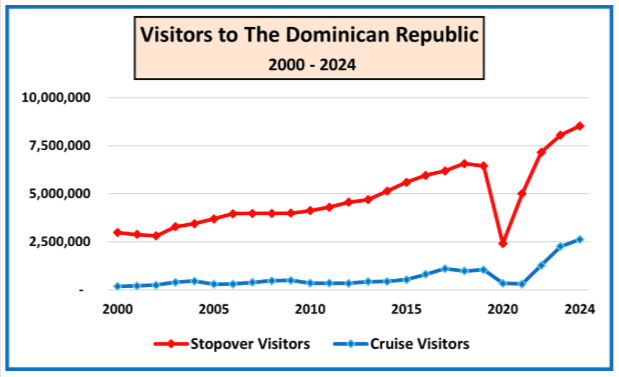
The long-term visitation trend tells the most important story for anyone evaluating Dominican Republic property investment. From 2000 to 2024, stopover visitor arrivals grew from 2,978,000 to 8,535,701 — before cruise visitors are even counted.
Why pandemic recovery matters to a real estate investor
The chart shows two things that matter: consistent long-term growth, and a full recovery after the pandemic shock of 2020. Markets that absorb a generational disruption and immediately return to record highs are markets with structural demand — not cyclical spikes.
“The DR absorbed a global pandemic that brought arrivals to 2,405,315 in 2020 — and set back-to-back records in 2024 and 2025. That kind of recovery tells you something real about underlying demand.”
2025 Full-Year Dominican Republic Visitor Results
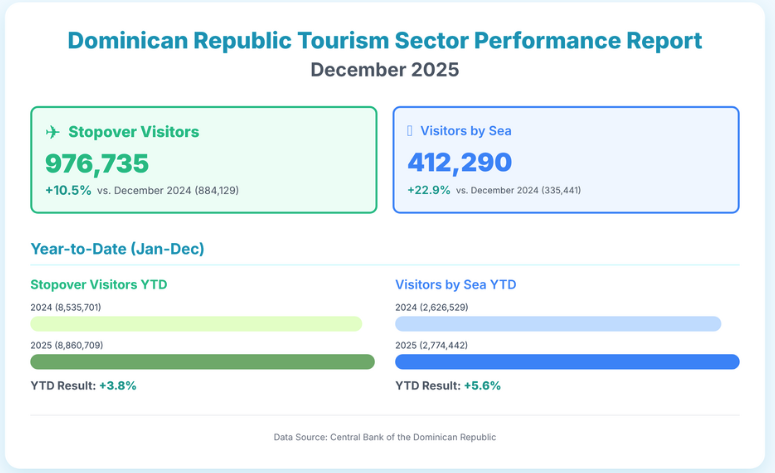
Total visitors in 2025 reached 11,635,151 — a new annual record. Here is how that breaks down by segment:
| Visitor Segment | 2025 Total | Year-over-Year Change | Relevance to Rental Investors |
|---|---|---|---|
| Air Stopover Visitors | 8,860,709 | +3.8% vs. 2024 | Drive hotel & short-term rental demand |
| Sea / Cruise Visitors | 2,774,442 | +5.6% vs. 2024 | Signal expanding infrastructure capacity |
| Total Visitors | 11,635,151 | +4.2% vs. 2024 | New annual record |
Source: Tourism Analytics / Central Bank of the Dominican Republic, CY 2025
Both segments grew, which matters. Air stopovers drive hotel and short-term rental demand — the category most relevant to an investor evaluating rental income potential. Cruise growth signals expanding port infrastructure capacity, which supports the long-term trajectory of the destination.
Canadian Investors and the DR: Source Market Data
In 2025, 1,144,242 Canadians visited the Dominican Republic — making Canada the second-largest source market for DR tourism at 12.9% of all air arrivals, behind only the United States at 36.9%.
| Source Market | 2025 Air Arrivals | Share of Total |
|---|---|---|
| United States | ~3,265,000 | 36.9% |
| Canada | 1,144,242 | 12.9% |
| All Other Markets | ~4,451,000 | 50.2% |
Source: Tourism Analytics, CY 2025 — Non-Resident Air Stopover Visitors by Country of Residence
Why Canadian market share matters for DR rental demand
This is not an emerging Canadian interest in the DR. Canadians have consistently ranked as the second-largest source market, representing 13% to 16% of air arrivals from 2007 through 2019, and returning to that range as the market recovered post-pandemic. In raw numbers: 174,625 Canadians in 1999, growing to over 1.1 million by 2025.
For a Canadian investor evaluating short-term rental demand, that context matters. A rental market drawing from a stable, high-volume base of North American visitors — many of them repeat travelers — carries less demand risk than one dependent on newer or more volatile source markets.
Hotel Occupancy Rates in the Dominican Republic: What the Data Shows
The hotel occupancy data, provided by ASONAHORES and cited by Tourism Analytics, shows the DR running at 75.0% average annual hotel occupancy in 2025 — with peak months exceeding 86%.
| Month | 2025 Occupancy | Note |
|---|---|---|
| January | 85.4% | Peak season begins |
| February | 86.8% | Highest month of the year |
| March | 82.1% | Peak season continues |
| April – August | 70–77% | Shoulder season; strong baseline |
| September | 58.2% | Softest month of the year |
| October – November | 65–72% | Recovery toward year-end |
| December | 80%+ | High season resumes |
| Full Year Average | 75.0% |
Source: ASONAHORES via Tourism Analytics, CY 2025
What the seasonality pattern means for Canadian property owners
Two things stand out for a rental property investor. First, the seasonality pattern: the high-occupancy months of December through April align almost exactly with when Canadian owners would most likely want personal use of the property — meaning the investment case and the lifestyle case can coexist without significant conflict. Second, even the softest month (September at 58.2%) represents a meaningful occupancy base.
Hotel occupancy is a proxy for overall destination demand, not a direct predictor of individual rental performance. But it establishes that the demand environment is real and consistent across all twelve months of the year.
Is Dominican Republic Tourism Still Growing in 2026?
| Period | Total Visitors | vs. Same Period 2025 | Hotel Occupancy |
|---|---|---|---|
| January 2026 | ~1,175,000 | +8.7% | — |
| February 2026 | ~1,214,000 | +11.3% | — |
| YTD Feb 2026 | 2,388,786 | +9.4% | 86.2% |
Source: Tourism Analytics & ASONAHORES, YTD February 2026
Yes — through the first two months of 2026, the Dominican Republic received 2,388,786 total visitors, up 9.4% from the same period in 2025. Hotel occupancy in the same period reached 86.2% — up 1.1 percentage points from 85.1% in early 2025. These are not the numbers of a market showing signs of saturation. They are the numbers of a market still growing into its capacity.
Dominican Republic Real Estate Supply vs. Demand: Is the Market Getting Oversaturated?
One of the legitimate questions any disciplined investor asks about a growing tourism market is whether supply is keeping pace with demand in a way that could eventually suppress returns.
| Year | Hotel Rooms (DR Total) | Change |
|---|---|---|
| 2021 | ~73,000 | Baseline |
| September 2025 | 92,142 | +26% in 4 years |
| 2023 pipeline | 10,060 rooms in 42 projects | Under construction |
Source: ASONAHORES
That is meaningful supply growth. And yet, over the same period, total visitor arrivals grew from post-pandemic lows back to record highs, with 2025 surpassing 2024 by over 470,000 visitors. The demand side has continued to match or outpace supply additions at the national level.
This does not mean every market segment within the DR reflects the same balance. Punta Cana — which handled 61.2% of all air arrivals in 2025 (5,418,362 visitors) — is a different supply-demand picture than Santo Domingo or emerging north coast markets. Micro-market matters significantly.
What Tourism Data Does — and Does Not — Tell Real Estate Investors
Visitor arrivals confirm demand. They do not confirm investment returns. The gap between the two is filled by factors the tourism data cannot answer:
- Property management qualityWho operates the asset day-to-day determines the gap between a well-performing rental and an underperforming one — even within the same location.
- Financing structure and carrying costsFull cost transparency — including maintenance, management fees, and financing impact — belongs in every projection you build.
- Title due diligenceTitle irregularities exist, particularly in older resale properties. This is the most commonly cited concern — and the most manageable with the right legal guidance.
- Currency riskReturns are typically generated and quoted in USD. Canadian investors hold CAD. That spread fluctuates and belongs in any projection.
- Tax implicationsCross-border tax treatment on both sides of the border requires specific professional guidance.
What the 25-year trend does confirm — clearly and credibly — is that the demand foundation for Dominican Republic real estate investment is real, durable, and still growing. That is a necessary condition for a sound investment. It is not a sufficient one.
The Honest Investment Case for Dominican Republic Real Estate
For a Canadian investor with an existing domestic portfolio evaluating where geographic diversification makes sense, the Dominican Republic meets several baseline criteria worth caring about:
| Criteria | DR Position |
|---|---|
| Demand durability | 25-year growth trend; recovered fully post-pandemic to record highs |
| Canadian market familiarity | #2 source market — 1.1M+ Canadian visitors annually |
| Occupancy baseline | 75%+ annual average; 86%+ in peak season |
| Government support | Structural stake in tourism sector; ongoing infrastructure investment |
| Entry price point | Competitive relative to other Caribbean and established Mexican markets |
| Foreign ownership rights | Same rights as citizens; protected through national Title Registry |
Summary: key criteria for a diversification-motivated Canadian investor
None of that is a reason to buy. It is a reason to look seriously, ask the right questions, and get the right guidance — from someone who knows both the market and the numbers behind it.
That is a different posture than being sold a dream. It is the posture this kind of decision deserves.
“Eleven point six million visitors in 2025. 86.2% hotel occupancy in early 2026. The data is not a reason to buy — it is a reason to have the right conversation.”
Frequently Asked Questions: Dominican Republic Real Estate Investment for Canadians
Can Canadians legally own property in the Dominican Republic?
Yes — Canadians can legally own property in the Dominican Republic with the same rights as citizens. The Dominican Republic grants foreign nationals full property ownership rights, registered through the national Title Registry (Registro de Títulos). The practical requirement is independent legal due diligence before any purchase. Title irregularities exist — particularly in older resale properties — and engaging a local attorney to verify clean title is not optional. For new developments, confirming proper permits and, where applicable, CONFOTUR approval, is equally non-negotiable. The legal framework is sound. The execution requires the right guidance.
What are the risks of buying investment property in the Dominican Republic as a Canadian?
The main risks are title risk, currency risk, management risk, and market concentration risk — all real and worth understanding before any decision. Title risk is the most commonly cited concern and the most manageable with proper legal due diligence. Currency risk is structural: returns quoted in USD fluctuate relative to CAD and belong in every projection. Management risk is often underestimated — the quality of property management directly determines the gap between a well-performing and underperforming rental in the same location. Market concentration risk is worth noting for Punta Cana specifically, given that 61.2% of all DR air arrivals flow through one corridor. Always evaluate net returns after fees, maintenance, vacancy, taxes, and currency conversion — not gross projections.
How do I manage a Dominican Republic property from Canada?
Most investor-grade properties in the DR’s major tourism corridors operate within professional, often hotel-branded, property management programs. These programs handle bookings, maintenance, guest services, and revenue distribution. Before purchasing, confirm the management fee structure and reporting terms in writing — management quality varies significantly between operators and shows up directly in occupancy rates and net income. Remote ownership from Canada works well when the management infrastructure is professional and transparent, but requires clear contractual terms and realistic expectations about net distributions after all costs are deducted.
How does Dominican Republic real estate compare to Mexico or Panama for Canadian investors?
Each market has a different risk and return profile. The DR’s primary advantages are proven tourism volume (11.6M visitors in 2025), Canada as the #2 source market, competitive entry pricing, and a straightforward foreign ownership framework. Mexico offers more mature resale liquidity in premium corridors, but foreign ownership involves a complex fideicomiso trust structure with added legal and carrying costs. Panama is better suited to residency and retirement seekers than pure rental investors — its beach and tourism rental demand is thinner than the DR at comparable price points. No market comparison replaces a property-level analysis of the specific asset, location, and operator you are evaluating.
Ready to Have the Right Conversation?
Get a grounded, data-backed perspective on whether international diversification fits your portfolio — with no pressure, no projections, and no hype.
Book a Call with RyanSources
- Tourism Analytics — Visitor Arrivals Data, CY 2025 & YTD February 2026
- Central Bank of the Dominican Republic — Tourism Sector Performance Report, December 2025
- ASONAHORES (Asociación Nacional de Hoteles y Turismo) — Hotel Occupancy Data via Tourism Analytics, 2025–2026
- ASONAHORES — Hotel Room Supply Data, 2021–2025